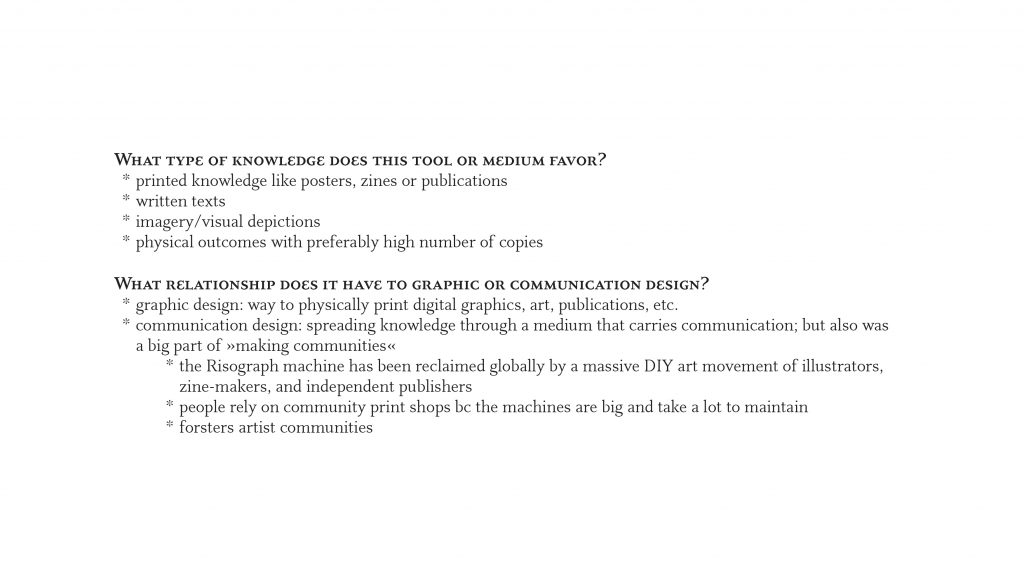
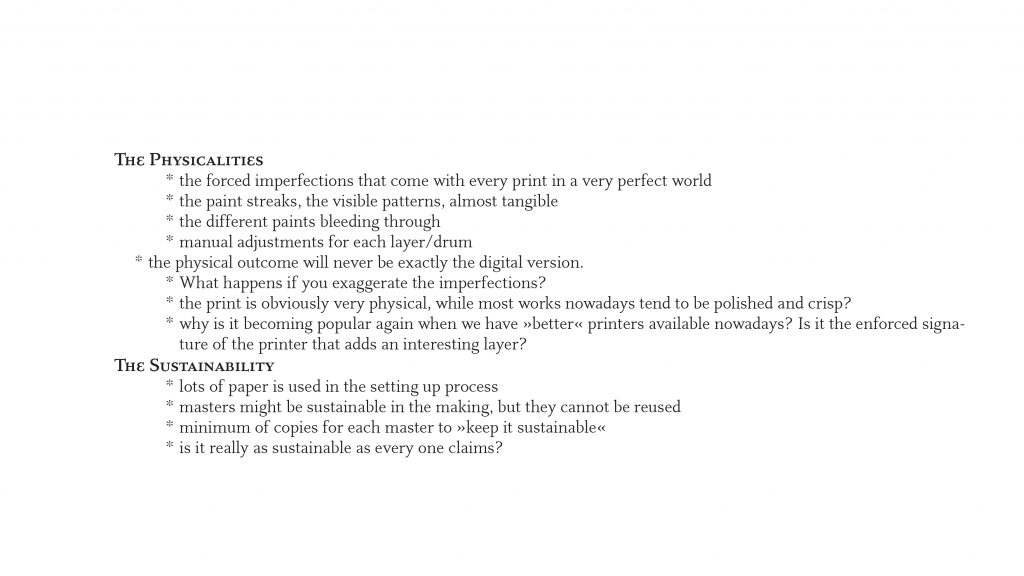
Week 2 started with a trip to the library. Over the weekend, I had decided I was most interested in the rise of riso (lol, what a word creation). What causes the surge in popularity, even though riso prints were lower quality than what modern inkjet printers can do? Is it the yearning for analogue things in a highly digital age? Or are the imperfections of riso print that charming?
Parts of my research included »The work of art in the age of mechanical reproduction« by Walter Benjamin (2008), as well as »The revenge of analog« by Sax (2016) and »The effort heuristic« by Kruger (2004). (More readings in the references).
I took two things away from this research:
1. Effort heurisitc
seeing and/or experiencing the effort/process of a product changes how we perceive it’s value. More effort equals more value (Kruger, 2004).
Does the process of riso printing change the value of a print for me personally?
2. Walter Benjamin
photography was the first time the hand was relieved of the principal responsibility which instead switched to the eye alone, allowing for a much faster process, that in turn has to take a loss in aura and genuineness.
What happens if you reintroduce the hands in the process of riso printing photography?
This informed the first version of my critical question:
Critical Question:
What causes the rise of risoprint? Is it the longing for the analogue medium in a digital age?
So for my practice in iteration, I picked a photograph from one of our family holidays and decided to reintroduce »the hands« by producing riso prints of it.

While producing this riso print version, I also played with the settings and deliberately tried to enhance the imperfections of riso printing: moving the layers apart, instead of perfectly overlapping. This created interesting (albeit a little crazy) effects.
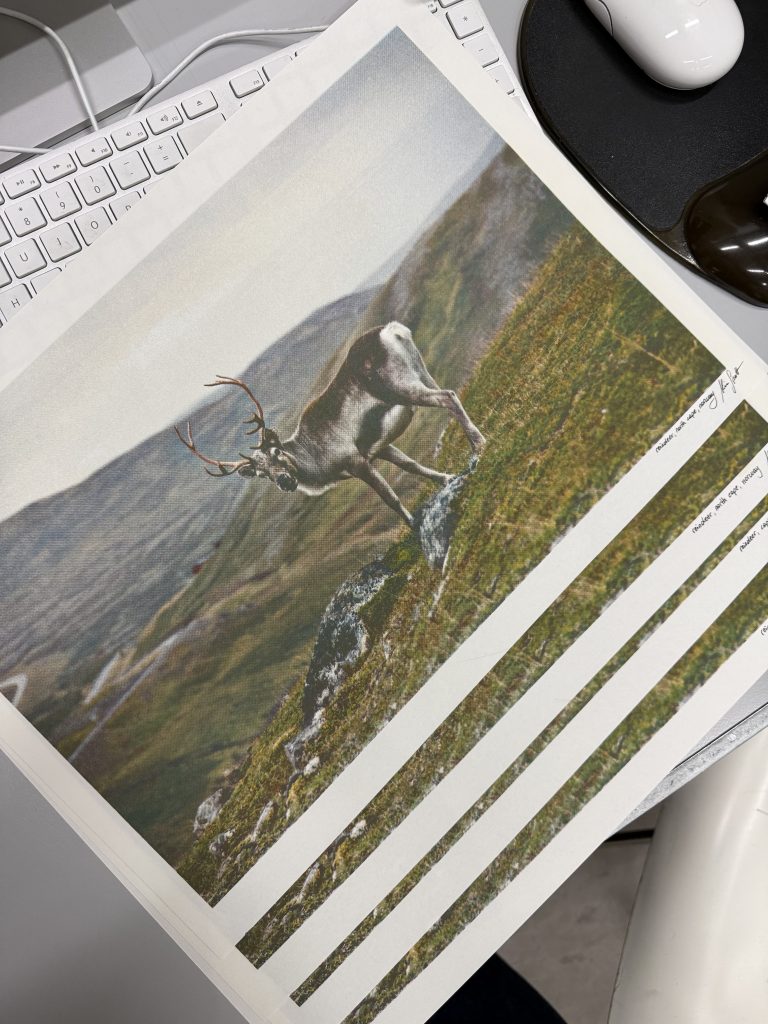
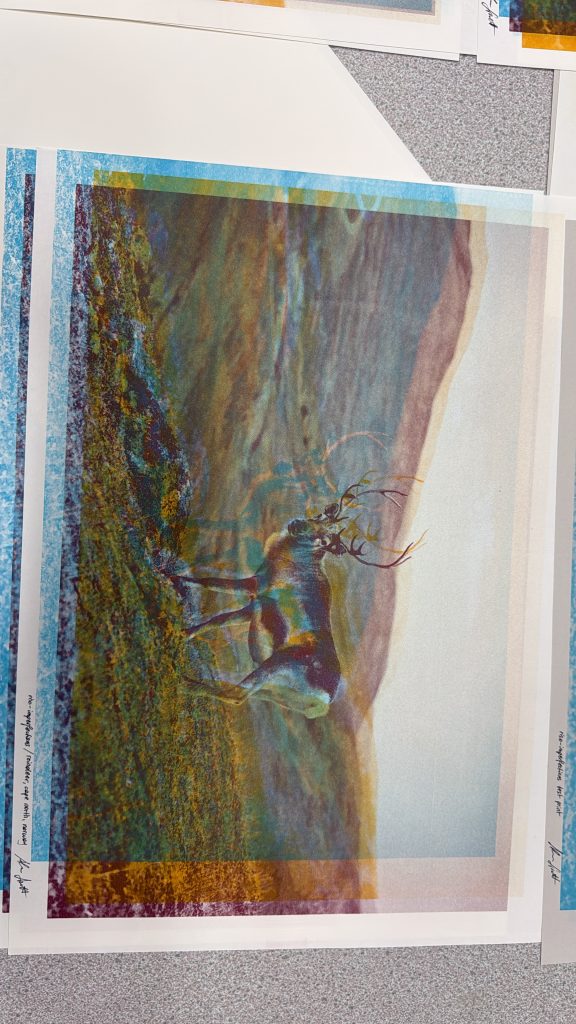
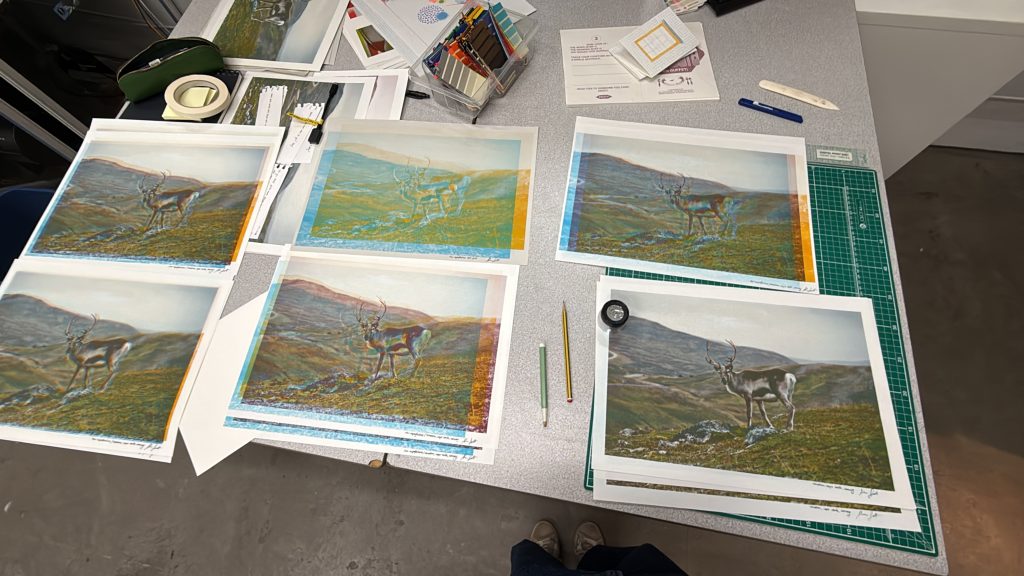
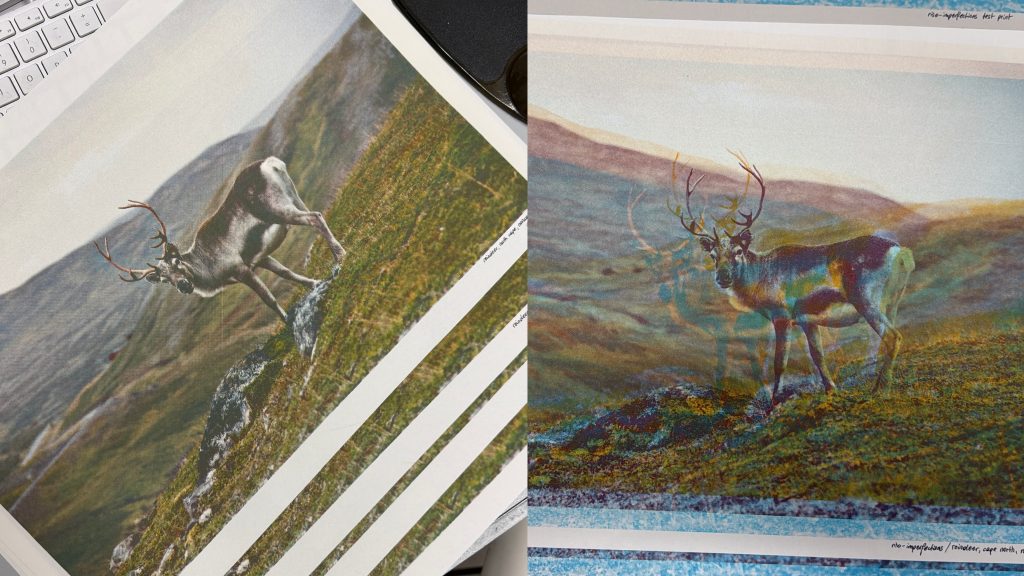
I then taped different versions of my prints to spots around the universiyt along with 5 questions I asked people to answer. There was an inkjet print of the photograph, the perfect riso print, the trippy riso prints and a little collection of test prints saved throughout the process to visualise how long it took.
The 5 questions were:
Which print (inkjet or riso) has more value to you? Why?
Which print holds more human value to you? Why?
Do you think prints made through more human effort hold more value than prints »just printed by a modern printer«?
This is a collection from the setup process for the riso prints. Seeing how much effort it took, does the riso print now hold more value for you?
Look at these exaggerated imperfections. Do you think they add human value or take value away?

I wish I had gotten more answers, but the ones I did get, were still useful. Especially one phrase: »Imperfections have always been a hallmark of humanity«.
So are we craving humanity? Human hallmarks? Human maker marks? Do we reach for the never-drying riso, the streaky riso, the slightly dull riso, the slightly off riso because it connects to us being human? Can we feel that someone touched it, handled it?
This prompted me to rephrase my critical question:
Critical Question 2.0:
Can the imperfections of risograph be reframed as fingerprints of a human-driven process in a highly digital world? And is this blatant visibility of imperfection as the human hallmark what causes the rise of risoprint and trends of cultivating handcraft-driven lifestyles?
At the end of week 2 I wanted to further explore these imperfections that I had labelled as »human fingerprints«. I wanted to iterate on them and find a way to bring more focus towards them. The feedback also directed me that way, asking how »realness vs. digital appreciation« could be shown, »how to upscale the imperfections«.